To the spiritual leaders of the church at Corinth, the Apostle Paul issued the challenge: Be watchful, stand firm in the faith, act like men, be strong (1 Cor 16:13). Men are called to lead their homes and churches with spiritual power. This calling of Christian men to spiritual strength is one of the reasons for studying the life of Elijah. The spiritual might and power of Elijah are well known. In fact, when the angel of the Lord wanted a metaphor to explain to Zechariah the spiritual might his promised son, John the Baptist would wield, the angel said he would go before the Messiah in the spirit and power of Elijah. This episode examines the source of Elijah’s spiritual power, his astonishing faith.
One of God’s descriptions of the way Christ-followers are to live is by faith. Habakkuk writes “The just shall live by faith” (2:4). Paul writes, “We walk by faith and not by sight” (1 Cor 5:6). In Hebrews 11:6 we read “Without faith it is impossible to please God.” God wants us to trust him with our whole life:
- With our past—how past scars and events he's allowed are part of his good, perfect plan.
- With our present—trusting him right now, today, to give us the grace to handle the problems and pressures that we face, instead of thinking we can meet them in our own strength or the opposite, that they will crush us.
- With our future—being confident that though we do not know what the future holds we do know who holds the future. Because we know him, we can trust him to take us down the right path and hold our hand as we walk.
Living daily by faith is not only the way God has spelled out for us to please him; it is also the most exciting, dynamic, rewarding way we could ever spend a lifetime. But such a life, like that of Elijah, requires leaving our comfort zone and stepping out in obedient response to Christ's call, no matter how tough that assignment. So, let’s look to the example of this spiritually powerful leader and his faith.
When we left our study of 1 Kings 17:16 last week, Elijah, whose name means YAHWEH IS GOD, was stuck hiding in a land ruled by Jezebel’s father, Ethbaal, whose name means WITH BAAL.
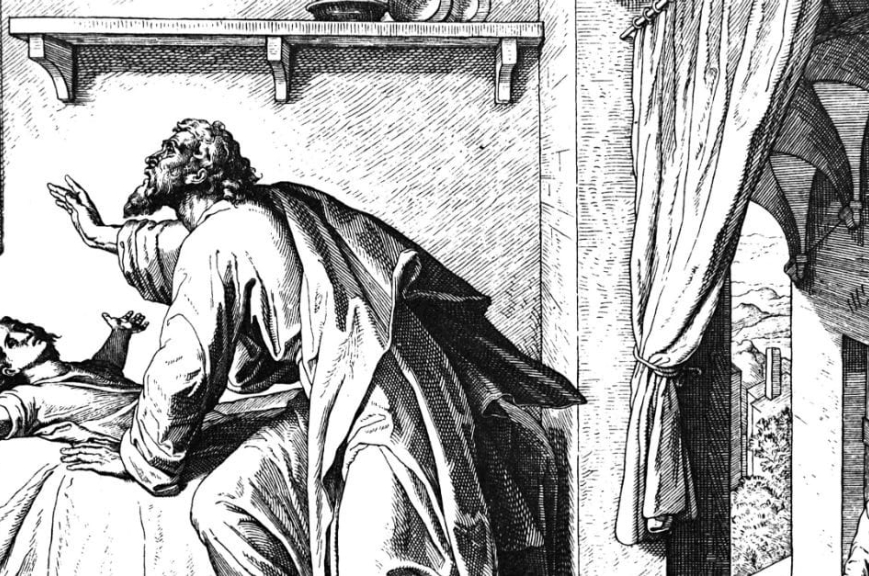
After this the son of the woman, the mistress of the house, became ill. And his illness was so severe that there was no breath left in him. And she said to Elijah, “What have you against me, O man of God? You have come to me to bring my sin to remembrance and to cause the death of my son!” And he said to her, “Give me your son.” And he took him from her arms and carried him up into the upper chamber where he lodged, and laid him on his own bed. And he cried to the Lord, “O Lord my God, have you brought calamity even upon the widow with whom I sojourn, by killing her son?” Then he stretched himself upon the child three times and cried to the Lord, “O Lord my God, let this child's life come into him again.” And the Lord listened to the voice of Elijah. And the life of the child came into him again, and he revived. And Elijah took the child and brought him down from the upper chamber into the house and delivered him to his mother. And Elijah said, “See, your son lives.” And the woman said to Elijah, “Now I know that you are a man of God, and that the word of the Lord in your mouth is truth” (17:17-14).
Elijah’s Walk of Faith
A. Elijah’s faith has grown. Notice how God enabled Elijah to overcome three foundational obstacles to our faith.
Obstacle # 1: Self-reliance is a virtue. God created us to exercise dominion—to rule our own lives and spheres of influence implementing his agenda of righteousness. He did not create us to be helpless victims run over by whatever life brings. Responsibility—knowing and doing what others are expecting of me—is a foundational godly attitude. But it can develop the habit of leaning upon ourselves too much. Complete self-reliance easily becomes pride, which prevents the growth of our faith. That is why God takes very strong, capable people, like Moses, David, and Paul and puts them in impossible situations. Elijah, similarly, was placed by God into situations where he had no alternative. He had to depend upon God for his daily bread and water, at the brook Cherith to be fed by ravens showing up every day and by God resupplying the oil and flour of the widow of Zaraphath.
Interestingly, God seems to have crushed any semblance of pride in Elijah—since the source of his daily bread and meat was a flock of unclean creatures that were to be detested according to Mosaic Law, ravens. Then in Zarephath, he was utterly dependent upon the poorest of the poor, a destitute widow at the point of starvation. It appears that God needed Elijah to be emptied of “self” before he could be filled with the Spirit by trusting God. God resists the proud but gives grace to the humble. Proverbs 3:5-6 warns of the danger of self-reliance: “Trust in Yahweh with all your heart and do not lean on your own understanding. In all your ways acknowledge him, and he will make straight your paths.”
Obstacle # 2: Deep in our sinful nature is a distrust of God’s character. When Satan attacks Eve in the garden he begins with an evil insinuation—that God is the kind of God who just might have created ALL the luscious, delicious fruit in the garden and then forbidden them the eat ANY OF IT. His words are, “Did God actually say, ‘You shall not eat of any tree in the garden’?” Satan plants the thought before Eve says a word, that God is so mean and selfish, he might have created all that luscious fruit—just to deprive them of eating it. He then accuses God directly of depriving them of something so wonderful that it would make them like gods—the knowledge of good and evil. Lingering in the hearts of all of Adam and Eve’s descendants is an evil quickness to accuse God of not being good.
God placed Elijah in the helpless situation that required him to trust God daily for food. God was taking Elijah through those demeaning days of helplessness to drive a truth deep into his soul: God is trustworthy. He is good. He keeps his promises every single day. And every day, with his own eyes, Elijah saw God’s goodness and faithfulness—ravens arriving with bread and meat. Every day, incrementally, the truth of God’s faithfulness was driven a little deeper into his soul. Every single hunger pain turned into an exercise of faith to develop confidence in God’s character. His Word can be trusted. His motives and character are good.
It is irrational to trust a being whose motives you doubt. That seems to be why the author of the book of Hebrews said, “Whoever would draw near to God must believe that he exists and that he rewards those who seek him” (Heb 1:6). Perhaps that is why Paul wrote: If God is for us, who can be against us? He who did not spare his own Son but gave him up for us all, how will he not also, with him, graciously give us all things (Rom 8:31). The cross settled the issue of God’s goodness once and for all!
Obstacle # 3: We love our comfort zone sometimes subtly turning a deaf ear to God’s call to leave it. Most of us can depend upon ourselves so long as we stay safely in our comfort zone. But when you look into God’s faith hall of fame you see those who left their comfort zone to obey God—like Abraham leaving his home in Ur of the Chaldees and setting out for the promised land or offering up his son Isaac and Moses who left the comfort of being treated as the son of Pharoh’s daughter choosing rather to be mistreated with the people of God or Rahab who risked being caught and executed as a traitor in Jericho. God calls those on this list who showed their faith by costly obedience those “of whom the world was not worthy.” What a legacy.
Elijah left his comfort zone and obeyed God by marching into Ahab’s place and declaring “As the Lord, the God of Israel, lives, before whom I stand, there shall be neither dew nor rain these years, except by my word.” He obeyed God by going to the brook Cherith. He obeyed God by setting out for Zarephath, though it was the center for the worship of Baal, having no idea how God would supply food and water as he made the 100 mile trip, nor how he would be protected from King Ethbaal, Jezebel’s father. Every time he stepped out of his comfort zone to obey God, Elijah discovered that God was faithful to his promises.
B. Elijah faces accusation. As we return to the story we read, “After this the son of the woman, the mistress of the house, became ill. And his illness was so severe that there was no breath left in him. And she said to Elijah, ‘What have you against me, O man of God? You have come to me to bring my sin to remembrance and to cause the death of my son!’” Notice how utterly unfair this accusation is. Elijah is being blamed for causing her son’s illness. I probably would have tried to respond to this woman’s overpowering feelings of grief logically, saying, “Look lady, if I weren’t here, your son and you would have died of starvation a long time ago.” But Elijah has the wisdom not to respond to her heartache with defensiveness or logic. Furthermore, he has the humility to recognize the truth of her premise—this doesn’t feel fair of God.
C. Elijah is confused. I Kings 17 continues And he said to her, “Give me your son.” And he took him from her arms and carried him up into the upper chamber where he lodged, and laid him on his own bed. And he cried to the Lord, “O Lord my God, have you brought calamity even upon the widow with whom I sojourn, by killing her son?” Elijah himself, is genuinely confused. This woman graciously shared her food. She trusted Yahweh, the true God, and opened her heart to Elijah. And then God allows her son to die. All of us have had feelings that God isn't treating us or those close to us fairly. Not being prophets of God, we don't have the power to reverse the situations! But notice what Elijah did. He took his confusion about this to God. We see that confusion in his question. God is tough enough to handle our doubts and one of the best things that we can learn from Elijah is to take our doubts to God. We don't have to be afraid of them.
After taking this doubt about God’s goodness to God, we aren’t told what thoughts flooded into Elijah’s mind. But by now Elijah had developed a whole portfolio of faith experiences when he trusted God and saw God come through. I wonder if Elijah's mind drifted to that portfolio. I wonder if he might have been thinking, “God told me to go to Ahab, and I went and I told him that there would be a drought coming and there was a drought. God sent me to the brook Cherith in terrain I was familiar with. He protected me from Ahab’s search parties. It was ridiculous to think that ravens would bring me bread and meat twice every single day but that is exactly what happened. And the minute I ran out of water God came by again directing me to a place where a widow would provide for me. Wouldn't you know I went and the exact person he said would be there was there to meet me. And then there were pictures in that gallery from every single day of that oil and flour not running out. Perhaps Elijah was reasoning, “You have been faithful and good every step along the way. I have no reason to doubt that you'll be faithful and good in this situation. I don't know what your plan is. But I do know you. So, I’m going to ask.”
D. Elijah’s persevering faith is rewarded. Then he stretched himself upon the child three times and cried to the Lord, “O Lord my God, let this child's life come into him again.” That was one bold request. Up until then there had never been an instance in Scripture of someone rising from the dead. The text continues. And the Lord listened to the voice of Elijah. And the life of the child came into him again, and he revived.
It is striking to me that Elijah did not just stretch himself over the child and make this request once! Elijah knows something about prayers that God answers. We must persevere in asking. James 5 tells us that he prayed for 3.5 years over the drought and its purpose—to bring about repentance from worshipping Baal, the Canaanite rain God returning to the worship of Yahweh. That is 1277 days. If Elijah asked God three times per day to bring repentance to Israel and keep the drought up until they did, he would have asked God over 3800 times to do so. I don’t mean to discourage us. But Scripture is exceedingly clear about persevering in prayer—and not giving up. For example, consider Jesus’ teaching in Luke 5.
And he said to them, “Which of you who has a friend will go to him at midnight and say to him, ‘Friend, lend me three loaves, for a friend of mine has arrived on a journey, and I have nothing to set before him’; and he will answer from within, ‘Do not bother me; the door is now shut, and my children are with me in bed. I cannot get up and give you anything’? I tell you, though he will not get up and give him anything because he is his friend, yet because of his impudence he will rise and give him whatever he needs. And I tell you, ask, and it will be given to you; seek, and you will find; knock, and it will be opened to you. For everyone who asks receives, and the one who seeks finds, and to the one who knocks it will be opened. What father among you, if his son asks for a fish, will instead of a fish give him a serpent; or if he asks for an egg, will give him a scorpion? If you then, who are evil, know how to give good gifts to your children, how much more will the heavenly Father give the Holy Spirit to those who ask him!”
The ESV text notes explain the word translated “impudence,” the Greek word ANAIDEIA: “It is used only her in the NT. In all of its other known uses in ancient literature, the term means ‘lack of sensitivity to what is proper,’ i.e. ‘impudence,’ or ‘impertinence.’ It would indicate that the friend is shamelessly and boldly awakening the neighbor.” That perspective seems to be the urgency that it would be so wrong not to show hospitality to the visitors that it overcomes the embarrassment of inconveniencing the neighbor. Remember that in that culture, showing hospitality was a moral absolute. When there is a moral urgency, when we are hungering and thirsting for righteousness to cover the earth, we are on the firmest ground to repeatedly make a request of God.
We don’t know how many times Elijah would have stretched his body over the child and articulated his request. Maybe he would have kept doing this seven times as he had to do on Mt Carmel for the rain to come. Maybe more. But we do know one thing: Elijah expected to have to persevere in prayer before God would answer.
THE GROWTH OF THE WIDOW’S FAITH
And Elijah took the child and brought him down from the upper chamber into the house and delivered him to his mother. And Elijah said, “See, your son lives.” And the woman said to Elijah, “Now I know that you are a man of God, and that the word of the Lord in your mouth is truth.”
A. She witnessed a true miracle and drew the correct conclusion from it. In a great many churches in this country the application of this text would be “look for a miracle in your life today and come to our healing service this evening.” But the widow's son was not healed at a healing service. This miraculous resurrection was performed by God’s prophet, one speaking truth from God. The widow drew precisely the conclusion from the miracle that God intended. “Now I know that you are a man of God, that the word of the Lord from your mouth is true.”
Miracles have a very precise purpose in Scripture. They are given to authenticate the fact that those who claim to speak God's word are truly from God. Consider:
- Exodus 4:1: Moses says to God, “What if the children of Israel do not believe me or listen to me and say Yahweh did not appear to you?” Then what does God do. He turns Moses’ staff miraculously into a snake. Then his hand becomes leprous. Notice verse 8: “Then the Lord said, ‘If they do not believe you or pay attention to the first miraculous sign, they may believe the second.’” These two miraculous signs authenticated that Moses was speaking God’s words.
- John 10:37-38: Jesus said, “Do not believe me unless I do what my father does. But if I do it, even though you do not believe me, believe the miracles that you may know and understand that the father is in me and I am in the father.” Jesus is the ultimate revelation of God and his miracles authenticate it.
- John 14:11: Jesus said, “Believe me when I say that I am in the Father and the Father is in me, or at least believe on the evidence of the miracles themselves.”
- Hebrews 2:3-4: We read “Salvation was declared at first by the Lord, and it was attested to us by those who heard, while God also bore witness by signs and wonders and various miracles and by gifts of the Holy Spirit distributed according to his will.”
- 2 Corinthians 12:12: Here, Paul refers to “the things that mark an apostle, signs wonders and miracles were done among you.” Apostles are the New Testament prophets. Their writings became Scripture.
- Ephesians 2:20 explains that the writings of the OT prophets and NT apostles are the foundation for the church. But you are fellow citizens with the saints and members of the household of God, built on the foundation of the apostles and prophets, Christ Jesus himself being the cornerstone. The authority of Jesus was delegated to his apostles, which was authenticated by their miracles. Their writings then became the NT cannon.
No one has ever had the same miracle working power that God invested in Christ’s apostles because the final revelation of God is through his Son and carried to us by those he appointed to do so, his apostles. Their words and testimony make up the New Testament.
B. The widow witnessed that the God of the Bible works supernaturally and is the God of impossible situations. This feminine model of faith trusted God enough to spend her last ounce of oil and handful of flour to bake something for Elijah. Only after that act of trust did she see the oil and flour replenished supernaturally to feed her son and herself. Then, every night, as she went to bed, she had no flour and oil for the next day. And every new day brought the experience of God supernaturally supplying enough for another day. We don’t know what she expected Elijah to do, when he scooped her son up, but she certainly had learned that the God of Israel is the God of impossible situations.
Elijah’s astonishing faith led to the first resurrection from the dead in history. And there are even greater feats ahead for Elijah. But today’s story reminds us that the spiritual strength we long for as men, the renowned spiritual power of Elijah’s faith that we just studied, did not immerge out of thin air. The muscles of his faith were intentionally bulked up by God putting him into impossible situations, Elijah choosing to trust God in them, and proving the genuineness of his faith through his obedience. The opportunities to grow his trust in Yahweh—a heart attitude that is more precious to God than gold is to us—began as frustrating, painful, humbling situations that forced him to live by faith.
Because God loves US and knows that in eternity, we will celebrate our level of trust in him when going through hard times, God will bring similar challenges across OUR path. The day will come when, as author Chuck Swindoll says, “We are all faced with a series of great opportunities brilliantly disguised as impossible situations.” It is for US to reject doubt, eschew complaining, and seize those opportunities to prove our trust in our Redeemer.
For Further Prayerful Thought.
- In what way is self-reliance a virtue and in what way is it a form of pride that prevents us from depending fully upon God?
- What has most helped you overcome the sinful nature we all receive from Adam that makes us question God’s goodness?
- What do you see as the relationship between loving our comfort zone and growing our faith?
- How does Elijah’s approach to prayer relate to what Jesus taught about prayer in Like 5?


